Table of Contents
How California Regulates In-House Kimchi Fermentation at Retail Food Facilities
California’s food safety framework for retail establishments, from Korean restaurants in Los Angeles’s Koreatown to Korean BBQ operations throughout the Bay Area and Orange County, is governed by the California Retail Food Code (CalCode), the portion of the California Health and Safety Code that sets structural, equipment, and operational requirements for every food facility in the state. The provisions of the California Retail Food Code are primarily enforced by 62 local environmental health regulatory agencies. The California Department of Public Health, Food and Drug Branch, plays a supporting role by providing technical expertise to evaluate processes and procedures and to answer technical and legal inquiries for local agencies, industry, and consumers.
For kimchi fermentation, that division of responsibility matters practically: your HACCP plan review, your variance approval, your permit, and your inspections all go through your local county or city Environmental Health department, not through CDPH in Sacramento. In Los Angeles County, that is the LA County Department of Public Health, Environmental Health Division. In San Francisco, the San Francisco Department of Public Health. In Orange County, the OC Health Care Agency. In each of California’s 58 counties, the local EHS office is the authority reviewing your kimchi fermentation process before it can legally begin.
In accordance with Article 5 of the California Retail Food Code, food facilities may engage in certain activities through the use of a HACCP plan. Contact your local environmental health services to obtain information about HACCP requirements for the following food activities. Fermentation of TCS foods is explicitly among those activities. Kimchi involves cut napa cabbage held at room temperature during fermentation for far longer than the standard four-hour limit. That is the exact departure from default food safety rules that triggers the specialized process requirement and the need for a HACCP plan approved by your local EHS before the first batch enters fermentation.
The CDPH-FDB Role: What Goes to the State and What Stays Local
This distinction trips up many California operators, especially those who have read about CDPH-FDB involvement in retail food HACCP processes and assumed the state agency reviews all specialized process applications. It does not, for kimchi.
Certain high-risk food processes require that a HACCP plan must be approved, prior to implementation, by CDPH-FDB, specifically: using acidification or water activity to prevent the growth of Clostridium botulinum, and packaging potentially hazardous food using a reduced-oxygen packaging method. Kimchi fermentation does not fall under either of these two CDPH-FDB-specific categories. Traditional kimchi fermentation uses natural lactic acid bacteria to generate acid over time, not added acidulants to prevent C. botulinum growth as a primary mechanism. The review and approval authority for kimchi fermentation HACCP plans sits with your local county Environmental Health department.
A variance is a written document issued by the California Department of Public Health, Food and Drug Branch, that authorizes a modification or waiver of one or more requirements of the California Retail Food Code. Processes requiring a HACCP plan and a variance approved by CDPH-FDB include cooking food to lower temperatures than specified, such as with sous vide, and using acidification or water activity to prevent the growth of Clostridium botulinum. Fermentation methods may also require a HACCP plan and variance, with the applicable local authority determining the specific requirements.
In practice, most California county EHS offices handle kimchi fermentation as a local specialized process requiring a HACCP plan and county-level variance, submitted to and approved by the local authority. Contact your specific county EHS office to confirm their process, required forms, any applicable fees, and their review timeline before assembling your plan. Los Angeles County, Orange County, San Diego County, and Santa Clara County each have their own intake processes, and operating on an assumption that is specific to a different county creates delays.
Why Kimchi Fermentation Is a Specialized Process Under CalCode
The biological logic behind the specialized process requirement is the same in California as everywhere else, and understanding it helps you build a HACCP plan that addresses the hazards California EHS reviewers are evaluating.
Kimchi involves cutting, breaking, and damaging the leaves of napa cabbage and holding the product above refrigerated temperature for an extended time during preparation and fermentation. Storing the vegetable at room temperature for an extended period beyond four hours is not allowed under regular food code rules, which is why it must be specifically approved as a special process. California’s food code, like the FDA Food Code it is substantially based on, restricts TCS food from being held in the temperature danger zone between 41°F and 135°F beyond defined time limits. Kimchi fermentation necessarily operates within that zone for its entire duration, and the safety mechanism that makes it permissible is the progressive pH drop driven by lactic acid bacteria.
When fermentation is used to process TCS foods like cut cabbage, the conditions required for fermentation also create conditions that support the growth of pathogenic bacteria if the process is not controlled correctly. If a deviation from the fermentation process causes the fermenting bacteria to not produce enough acid, the food item may support growth of Clostridium botulinum. E. coli and Salmonella are also hazardous bacteria that can proliferate in anaerobic conditions when poor sanitization and hygiene practices contaminate the food prior to fermentation. Your HACCP plan must demonstrate that your specific process, your recipe, and your monitoring procedures reliably prevent these hazards from reaching the finished product.
What California EHS Reviewers Require in Your Kimchi HACCP Plan and Variance Application
California’s CalCode HACCP plan requirements under Section 114419 follow the same seven-principle framework as other FDA Food Code-based states. The plan must document a complete hazard analysis, identify CCPs, establish critical limits, define monitoring procedures, specify corrective actions, establish verification activities, and define recordkeeping requirements. Beyond that framework, California county EHS offices commonly require supporting scientific evidence that your specific process achieves the required pH within your proposed fermentation window.
If a facility wants to use their own recipe, they must prepare test batches that are not for public consumption, and send them to a laboratory for validation of pH below 4.2. The facility should have the recipe and the validation results ready before contacting the health department for special process approval. California county EHS offices invoke the requirement for supporting scientific data in a manner consistent with what the FDA Food Code allows, and a laboratory validation report for your specific kimchi recipe is the most direct way to satisfy that requirement. Have your recipe finalized before beginning the approval process, submit test batches to an accredited food testing laboratory, and include the results with your submission.
The plan review also evaluates whether the facility can physically accommodate the special process. This means the facility must have ample food preparation space, refrigerated space, and storage space for ingredients, utensils, and containers, along with good sanitation practices. Fermentation containers must be approved for acidic foods. California EHS reviewers may inspect the physical facility as part of the approval process for a kimchi fermentation HACCP plan, particularly in high-volume operations or where the facility’s layout raises questions about sanitation practices during fermentation.
The Critical Control Points California EHS Reviewers Expect in Your Kimchi HACCP Plan
Your HACCP plan must document the complete process from ingredient sourcing through post-fermentation storage and service, with specific numeric critical limits at each CCP. California EHS reviewers check for all of the following.
CCP 1: Ingredient preparation and salt concentration. The initial salting and wilting phase is the first critical control. Maintaining the salt concentration specified in the validated recipe is essential for inhibiting the growth of disease-causing microorganisms during the early stage of fermentation, before lactic acid bacteria have had time to drive the pH to a protective level. Your plan must specify the exact salt percentage, how it is measured and verified for each batch, and the documented source of the validated salt concentration in your formulation.
CCP 2: Fermentation temperature and approved time window. Your HACCP plan must document the fermentation temperature range and the maximum approved fermentation time within which the pH target must be reached. Fermentation temperature affects the rate of lactic acid production: too cold and fermentation stalls; too warm and conditions favor competing pathogens. The approved time window is the outer limit of room-temperature holding, not a suggestion.
CCP 3: pH monitoring at 12-hour intervals. pH must be checked every 12 hours throughout the fermentation period, up to the approved maximum duration. Every reading must be logged with the time, the result, and the responsible staff member’s initials. A calibrated pH meter is the required primary monitoring instrument. California EHS inspectors check calibration records alongside pH logs. Test strips may be accepted as a backup method only; confirm your local EHS office’s position on this before finalizing your monitoring procedure.
CCP 4: Critical pH limit of 4.2 or below. Kimchi becomes safe when the fermentation process produces enough natural acid to lower the product’s pH to 4.2 or below. The recipe must have validation certifying that the product will reach pH 4.2 or below. If a batch does not reach pH 4.2 within the approved fermentation window, it must be discarded. Extended fermentation beyond the approved window is not a corrective action option.
CCP 5: Corrective action for failing batches. When pH has not reached 4.2 within the approved window, the batch is discarded immediately. The discard event must be logged with the batch ID, the failing pH reading, the date and time, and the staff member responsible. The corrective action record is required even when the outcome seems obvious.
CCP 6: Post-fermentation refrigerated storage. Once pH is confirmed below 4.2, kimchi is stored in the refrigerator at or below 41°F. Every container must be labeled with a batch ID and preparation date. Storage temperature logs must accompany fermentation records in the HACCP binder.
Staying Compliant After Your California County EHS Approves Your Kimchi Plan
Approval from your local county Environmental Health department is the authorization to begin fermentation. From that point, every batch must follow the approved plan exactly, with complete records maintained and available at every routine inspection.
Enforcement of the California Retail Food Code is granted to the 62 local environmental health regulatory agencies of California. These agencies conduct unannounced inspections and the frequency depends on the establishment’s risk classification. A food facility fermenting kimchi under a specialized process variance is classified at a higher risk level than a standard restaurant, which means more frequent EHS visits and closer scrutiny of HACCP documentation at every one of them. Your pH logs, calibration records, corrective action entries, and batch production records must be current every operating day.
California’s placard system makes inspection outcomes publicly visible. A green placard signals that the facility passed. A yellow conditional placard signals violations requiring correction and a follow-up inspection. A red placard means the facility must close until compliance is demonstrated.
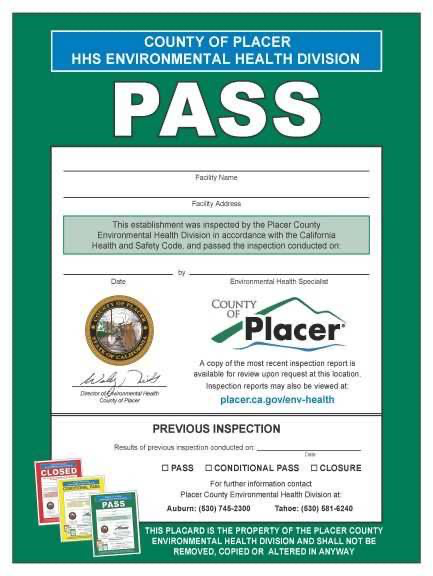
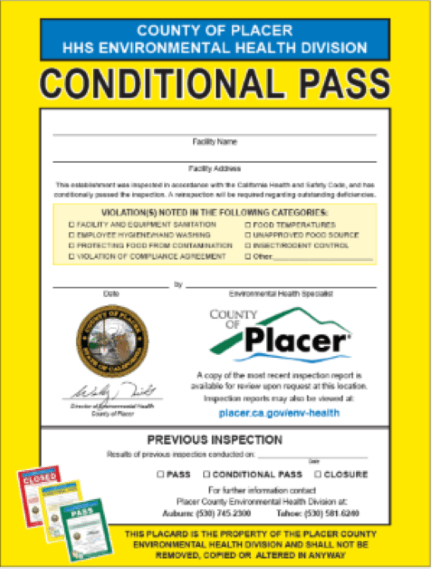
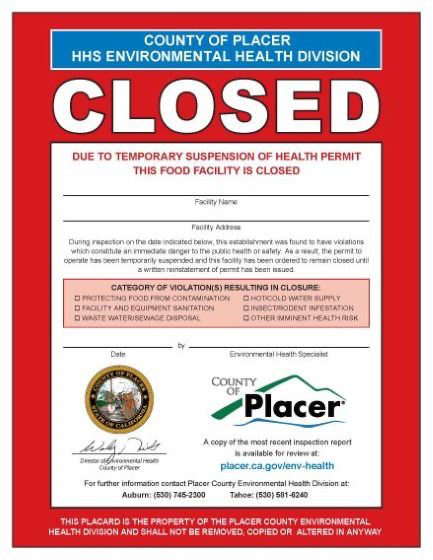
For a food facility operating a kimchi fermentation process, HACCP documentation failures, including missing pH logs, inadequate monitoring frequency, or operations outside the approved plan, are findings that can support a yellow or red placard posting depending on the nature and severity of the violation.
Any change to the approved process requires notifying your county EHS office before implementation. A different cabbage supplier, a modified salt concentration, a changed fermentation temperature, or a new container type all potentially affect pH achievement and the safety of the finished product. A change to the validated recipe requires new laboratory validation before a re-approval is granted. Operating the changed process under the original approval means operating outside that approval.
California’s cottage food law does not extend to fermented TCS foods. Kimchi produced at home for sale, however small the scale or local the customer, is not permitted under any California exemption. The facility must be a licensed food establishment operating under an approved HACCP plan and variance from the county EHS.
Common Reasons California Kimchi Operations Fail EHS Inspection
The failure patterns at California food facilities producing kimchi under a fermentation variance are consistent across LA County, the Bay Area, Orange County, and other regions with significant Korean food service operations.
Fermenting kimchi without a county-approved HACCP plan and variance. This is the foundational violation and the most common. A Korean restaurant that ferments kimchi in-house, as most have done for years based on family recipes and traditional practice, is conducting a specialized process under CalCode without the required approval. California EHS inspectors who discover this during a routine inspection are required to document the finding, and the facility must cease fermentation until the approval process is complete. This is not a warning to note for later. It is an immediate compliance issue with permit implications.
Confusing CDPH-FDB involvement with local EHS authority. Operators who submit kimchi fermentation plans directly to CDPH-FDB in Sacramento, believing the state agency reviews all retail HACCP plans, cause delays when the agency directs them back to their local EHS. Fermentation plans go to your county Environmental Health department first. CDPH-FDB provides technical support to local agencies but is not the approving authority for standard retail fermentation processes.
Recipe changes made without re-approval or lab revalidation. A California kimchi producer who changes their cabbage source, adjusts their salt ratio for flavor reasons, or modifies their paste recipe without notifying their county EHS is operating a different process than the one approved. If that change affects pH achievement, the original lab validation no longer covers the current product. California EHS inspectors who identify discrepancies between the approved formulation and the current process cite this as a priority finding.
pH logs with missing entries or monitoring frequency below the approved schedule. Every batch requires a logged pH entry at 12-hour intervals throughout fermentation. California EHS inspectors count log entries against batch production records. A batch fermented for 48 hours with only two pH entries instead of four is a documentation failure, regardless of whether the final pH was acceptable.
Fermentation containers not rated for acidic foods. Kimchi fermentation requires special food service containers approved for acidic foods. Standard food service containers not rated for acid contact are an equipment violation under CalCode. Your HACCP plan must document the specific containers used, and those containers must be present and in use at inspection. Using inappropriate containers that could leach materials into an acidic ferment is a food safety issue, not just a documentation gap.
The inspection you just passed? It will happen again.
California food facilities are inspected unannounced by county EHS on a risk-based schedule, and every batch log, pH record, and corrective action needs to be complete every time an EHS specialist arrives. HACCPEasy Platform gives your team a digital compliance system so the next inspection is a non-event.
- ✓ Operators log batches, temps, and corrective actions in real time
- ✓ Require photo evidence of pH readings, equipment checks, or any critical step
- ✓ If-Then logic flags deviations and locks the workflow until resolved
- ✓ One tap exports your full 180-day audit history when an inspector walks in
Start your 7-day free trial — from $79/month, no credit card required
Bottom line
Fermenting kimchi in a California food facility requires a HACCP plan and variance approved by your local county Environmental Health department before the first batch enters fermentation. The rules are set by CalCode under California Health and Safety Code, enforced by 62 local EHS agencies, and CDPH-FDB in Sacramento is not the approving authority for standard retail kimchi fermentation. Your county EHS reviews the plan, issues the approval, and returns to inspect compliance on an ongoing basis. The pH target is 4.2 or below, monitored every 12 hours with a calibrated pH meter, with laboratory validation of your recipe commonly required before approval is granted. Acid-rated fermentation containers, complete batch records, refrigerated storage at 41°F after pH is confirmed, and corrective action documentation for every failing batch complete the compliance picture. Any recipe or process change requires re-notification and potentially new lab validation before implementation. Home production is not a permissible pathway. Get the county approval first, document every batch, and the inspection becomes routine.
FAQ
- Does my California restaurant need a HACCP plan to ferment kimchi in-house? Yes. Under CalCode Article 5, fermenting cut napa cabbage at room temperature is a specialized process that requires a HACCP plan approved by your local county Environmental Health department before the process begins. You cannot legally ferment kimchi for room-temperature service or for sale to customers without this approval in place. Contact your county EHS office to confirm their specific application process, required forms, and fees.
- Do I submit my California kimchi HACCP plan to CDPH in Sacramento or my local county? Your local county Environmental Health department, not CDPH-FDB in Sacramento. CDPH-FDB has direct approval authority only for two specific high-risk retail processes: using acidification or water activity to prevent Clostridium botulinum growth, and reduced oxygen packaging. Standard kimchi fermentation does not fall under either category. Submit your HACCP plan and variance application to your county EHS: LA County Environmental Health in Los Angeles, the SF Department of Public Health in San Francisco, or the equivalent office in your county.
- What pH does my kimchi need to reach to pass a California EHS inspection? The critical limit for kimchi fermentation under CalCode’s specialized process framework is a pH of 4.2 or below. This target must be reached within the fermentation window specified in your approved HACCP plan, verified by a calibrated pH meter checked every 12 hours during fermentation. If a batch does not reach pH 4.2 within the approved window, it must be discarded and the event recorded as a corrective action.
- Do California county EHS offices require lab testing of my kimchi recipe before approval? Most California county EHS offices require or strongly encourage laboratory validation of your recipe demonstrating that your specific formulation consistently achieves a pH of 4.2 or below within your proposed fermentation window. Prepare test batches before submitting your plan, have them evaluated by an accredited food testing laboratory, and include the validation results with your HACCP plan submission. Contact your specific county EHS office to confirm their exact requirements, as practices vary across California’s 62 local enforcement jurisdictions.