Table of Contents
What Hawaii Health Inspectors Are Looking For When They Walk Into a Sushi Operation
Sushi restaurants are one of the most visited food service categories in Hawaii, and they are also one of the most closely scrutinized by the Department of Health’s Food Safety Branch. The reason is specific: acidified sushi rice held at room temperature is a specialized process that requires documented controls, and the Food Safety Branch has the authority, and the habit, of verifying those controls are actually operating.
The Hawaii Department of Health (DOH) Food Safety Branch is the statewide licensing and inspection authority for all food establishments in Hawaii, operating under Hawaii Administrative Rules Title 11, Chapter 50, known as the Food Safety Code. This rule was significantly updated effective August 24, 2025, when Governor Green signed amendments aligning Hawaii’s code with the 2022 FDA Model Food Code. For sushi operations holding rice at room temperature, those updates matter: if your HACCP plan was written under the older 2013 Model Food Code framework and has not been reviewed since, you should confirm with your DOH island office that your current plan meets the updated requirements.
Unlike many mainland states where county health departments hold licensing authority, Hawaii administers food establishment permitting at the state level through island offices. Whether your operation is on Oahu, Maui, the Big Island, or Kauai, your permit comes from the DOH Food Safety Branch office serving your island. This statewide structure means the rules are consistent across the state, but your day-to-day contacts, permit applications, and inspection schedules are managed through your specific island office. Inspections are conducted on a risk-based schedule of one, two, or three times per year depending on how many food preparation steps your establishment performs, with sushi operations classified as higher-risk due to the specialized process involved.
Why Holding Sushi Rice at Room Temperature Requires a Variance Before You Begin Service
Under Hawaii’s Food Safety Code, using vinegar to acidify cooked rice so it can be held without temperature control is a specialized processing method. Any food establishment that wants to conduct a specialized process must obtain a variance from the DOH before operating that process. This is not a permit renewal formality: it is a separate, prior-approval process that requires a written application, a HACCP plan, and a $200 processing fee. The variance must be approved before you hold a single batch of acidified rice at room temperature.
The variance application requires specific documentation. You must submit a statement citing the relevant rule section, an explanation of the specialized process you want to conduct, an analysis demonstrating that the process will not create a public health hazard, and a HACCP plan meeting the requirements of HAR 11-50. The HACCP plan must identify the food products subject to the plan, the food safety hazards of concern, a flow diagram for the acidification process identifying each critical control point, your monitoring procedures, your corrective action protocols, and your verification procedures including record-keeping.
Once granted, variances in Hawaii are valid for up to two years and must be renewed before expiration. A lapsed variance means you are operating the acidification process without authorization, which is a direct violation of your food establishment permit conditions. DOH Food Safety Branch inspectors verify that your variance is current during every routine inspection, and an expired variance discovered during a routine visit is treated as a compliance failure, not a paperwork oversight.
If your operation holds sushi rice fully under temperature control, refrigerated at or below 41 degrees Fahrenheit or held hot at or above 135 degrees Fahrenheit, you do not need a variance. The variance requirement is triggered specifically by the choice to hold rice at room temperature using acidification as the safety control. Operations using vinegar for flavor only, without monitoring the pH or intending to hold the rice outside of temperature control, must still maintain the rice as a time/temperature control for safety food and apply standard temperature management.
The Critical Control Points Hawaii Sushi Operations Must Document for Every Batch
Hawaii’s Food Safety Code, aligned with the 2022 FDA Model Food Code framework, defines the critical control points for acidified sushi rice around pH control and holding time. Your approved HACCP plan must specify critical limits, monitoring procedures, corrective actions, verification activities, and record-keeping requirements for each CCP. Here is what inspectors look for in practice.
Finished pH at or below 4.2: This is the primary critical control point for the acidification process. The pH of 4.2 is the threshold below which Bacillus cereus and Staphylococcus aureus, the two pathogens of greatest concern in cooked rice, are controlled. A batch of rice that does not reach pH 4.2 cannot safely be held at room temperature, regardless of how much vinegar was added by volume. Every batch must be tested after vinegar mixing and before service. The reading must be recorded, along with the batch time and the name of the person performing the test. Your approved HACCP plan specifies when the test must occur, typically within 30 minutes of acidification, and the result must be documented in your pH log before service begins.
pH meter calibration: Your pH measurement instrument must be calibrated before each use using buffer solutions of known pH, typically pH 4.0 and pH 7.0. Calibration records must be maintained alongside your pH logs. Test strips are acceptable only if their margin of error of plus or minus 0.2 to 0.3 pH units is accounted for in how your corrective action protocol handles borderline readings. An uncalibrated instrument produces readings that your HACCP plan cannot rely on, and a batch tested with an uncalibrated meter is treated by inspectors as an unmonitored batch.
Corrective action for batches above pH 4.2: Your HACCP plan must define exactly what happens when a batch tests above 4.2. The standard protocol is to incorporate additional vinegar and retest. If the rice tests between 4.2 and 4.4 on the first reading, additional vinegar can be added and the rice retested with a documented corrective action entry. If the pH cannot be brought to 4.2 or below, the batch must be discarded or placed under temperature control and treated as a standard TCS food for the remainder of service. There is no discretionary judgment permitted at the service line: the corrective action protocol in your approved plan is the binding procedure.
Maximum room temperature holding time: Properly acidified sushi rice with a confirmed pH at or below 4.2 may be held at room temperature for up to 24 hours, though many operations apply more conservative internal limits. At the end of the holding period, remaining rice must be discarded. Your HACCP plan must include a procedure for labeling batches with preparation time and ensuring that rice is never used beyond the holding limit specified in your plan. Time tracking records are a required documentation element.
Person in charge review of pH logs: The person in charge must review pH log entries and initial them at least daily. This is not optional: it is a verification step required under your approved HACCP plan. Blank person in charge review columns in a pH log are treated by DOH inspectors as evidence that the HACCP plan’s verification component is not functioning, which is a direct compliance finding.
Staying Compliant Through Inspection Cycles, Recipe Changes, and the Updated Food Safety Code
Hawaii’s risk-based inspection schedule means sushi operations, as higher-risk establishments, may be inspected up to three times per year. Each inspection is unannounced, conducted during business hours, and can include a review of your variance status, your HACCP plan, your pH logs, your calibration records, your corrective action documentation, and a live demonstration of your pH testing procedure. If an inspector asks a staff member to demonstrate the calibration and testing process and they cannot do it correctly, that is a training deficiency finding even if your paper records are complete.
Recipe changes are the most common compliance trap for operations that have held a variance for several years. If you change your rice variety, switch vinegar brands, adjust your rice-to-vinegar ratio, or modify your mixing procedure, your finished pH may shift in ways that affect compliance. Changes that could affect the safety of the specialized process must be reported to the DOH and may require a new HACCP plan submission and updated variance before you implement the change. Operating a modified recipe under your existing variance approval without notifying the DOH is a variance violation.
Hawaii’s August 2025 update to the Food Safety Code, aligning with the 2022 FDA Model Food Code, is a relevant development for any operation whose HACCP plan was developed under the older 2013 framework. While the core pH limits and variance structure for acidified sushi rice are consistent across both versions of the code, specific procedural requirements, definitions, and documentation standards may have been refined. If your variance was issued more than two years ago, the renewal process is an appropriate time to review your HACCP plan against the current requirements and update it before submission.
Record retention is a minimum of 90 days for HACCP plan records under Hawaii’s rules, with longer retention periods recommended to cover the full inspection history between renewal cycles. Batch pH logs, calibration records, corrective action entries, and person in charge verification signatures must all be available for inspector review on-site during any inspection.
The Violations That Result in Yellow or Red Placards for Hawaii Sushi Operations
Hawaii uses a placard system for food establishments: green indicates the establishment passed its most recent inspection, yellow indicates a conditional pass with violations requiring correction, and red indicates closure for an imminent health hazard or permit suspension.
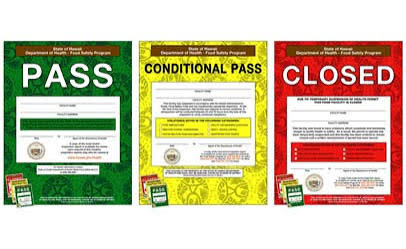
For a sushi operation, the fastest path to a yellow placard is incomplete or missing pH documentation. The second fastest is a variance that has lapsed without renewal.
Inspectors approach sushi operations with a specific checklist that covers the acidification process directly. Operations that cannot produce their current variance approval letter, a pH log with entries for every service period in recent history, calibration records tied to specific dates, and corrective action documentation when anything fell outside the critical limit are receiving yellow placard findings, not passing inspections.
The specific patterns that generate findings most consistently: pH logs that have entries for recent weeks but gaps in earlier periods, suggesting that record-keeping is done in response to inspections rather than as a daily practice. Corrective action columns that are blank across the entire log, because operators assume the process is working correctly without verifying it, and then have no documented response for the occasional batch that did test outside the critical limit. Staff members who can produce the HACCP plan binder but cannot describe the corrective action procedure when asked by an inspector, demonstrating that the plan exists on paper but has not been operationalized through staff training.
For multi-location sushi operations in Hawaii with establishments on different islands, each location holds its own food establishment permit and variance with the DOH office serving that island. The HACCP plan approved for your Oahu location is not automatically approved for your Maui location. Each island office handles its own variance applications and approvals, and both must be current and valid for each location where the acidification process is conducted.
The inspection you just passed? It will happen again.
Hawaii operations are re-inspected regularly and every batch, temperature log, and corrective action needs to be documented every time. HACCPEasy Platform gives your team a digital compliance system so the next inspector visit is a non-event.
- ✓ Operators log batches, temps, and corrective actions in real time
- ✓ Require photo evidence of pH readings, equipment checks, or any critical step
- ✓ If-Then logic flags deviations and locks the workflow until resolved
- ✓ One tap exports your full 180-day audit history when an inspector walks in
Start your 30-day free trial — no credit card required
Bottom Line
Hawaii requires a DOH variance and an approved HACCP plan before any food establishment can hold sushi rice at room temperature through acidification. The pH critical limit is 4.2, tested and documented for every batch before service. Your variance is valid for up to two years and must be renewed before it lapses. Hawaii’s Food Safety Code was updated in August 2025 to align with the 2022 FDA Model Food Code, which is worth reviewing if your current plan was developed under older requirements. Operations with complete pH logs, current calibration records, and staff who understand the corrective action protocol pass Hawaii DOH inspections without disruption. Operations that treat the pH log as a form to fill in periodically rather than a daily practice generate yellow placard findings and follow-up inspections.
FAQ
- Do I need a variance to serve acidified sushi rice in Hawaii? Yes. Under Hawaii Administrative Rules Title 11, Chapter 50, using vinegar to acidify cooked rice so it can be held without temperature control is a specialized processing method requiring a variance from the Hawaii Department of Health Food Safety Branch. You must apply for and receive written variance approval, along with approval of your HACCP plan, before operating the acidification process. The application fee is $200 and variances are valid for up to two years. If you hold your sushi rice fully under temperature control at or below 41 degrees Fahrenheit or at or above 135 degrees Fahrenheit, no variance is required.
- What pH does Hawaii require for sushi rice held at room temperature? The critical limit is pH 4.2 or below. This is the threshold at which Bacillus cereus and Staphylococcus aureus, the pathogens of greatest concern in cooked rice, are controlled. Every batch must be tested after vinegar mixing and the reading recorded before rice enters service. Your pH meter or test strips must be calibrated before each use, and calibration records must be maintained. Batches that test above 4.2 require a documented corrective action before any decision is made about whether they can be placed into service.
- What happens if my Hawaii DOH variance expires? Operating the acidification process with an expired variance is a direct violation of your food establishment permit conditions. DOH inspectors verify variance status during routine inspections, and an expired variance found during a visit is treated as a compliance failure. Renewal must be submitted to your island’s DOH Food Safety Branch office before the expiration date. If your variance lapses, you must revert to temperature control for your sushi rice, holding it at or below 41 degrees Fahrenheit, until a new variance is approved.
- Does Hawaii’s 2025 Food Safety Code update affect my sushi rice HACCP plan? Possibly. Hawaii updated its Food Safety Code effective August 24, 2025 to align with the 2022 FDA Model Food Code. If your HACCP plan was developed and approved under the older 2013 framework, the core pH limit and variance structure for acidified sushi rice remain consistent, but specific procedural requirements and documentation standards may have been refined. The variance renewal process is the appropriate time to review your plan against the current HAR 11-50 requirements and update it before resubmission. Contact your island’s DOH Food Safety Branch office if you are unsure whether your current plan meets the updated code requirements.